Surgery
Ankle arthroscopy
A minimally invasive operation that allows the surgeon to inspect the inside of the ankle and treat certain problems through small skin incisions.
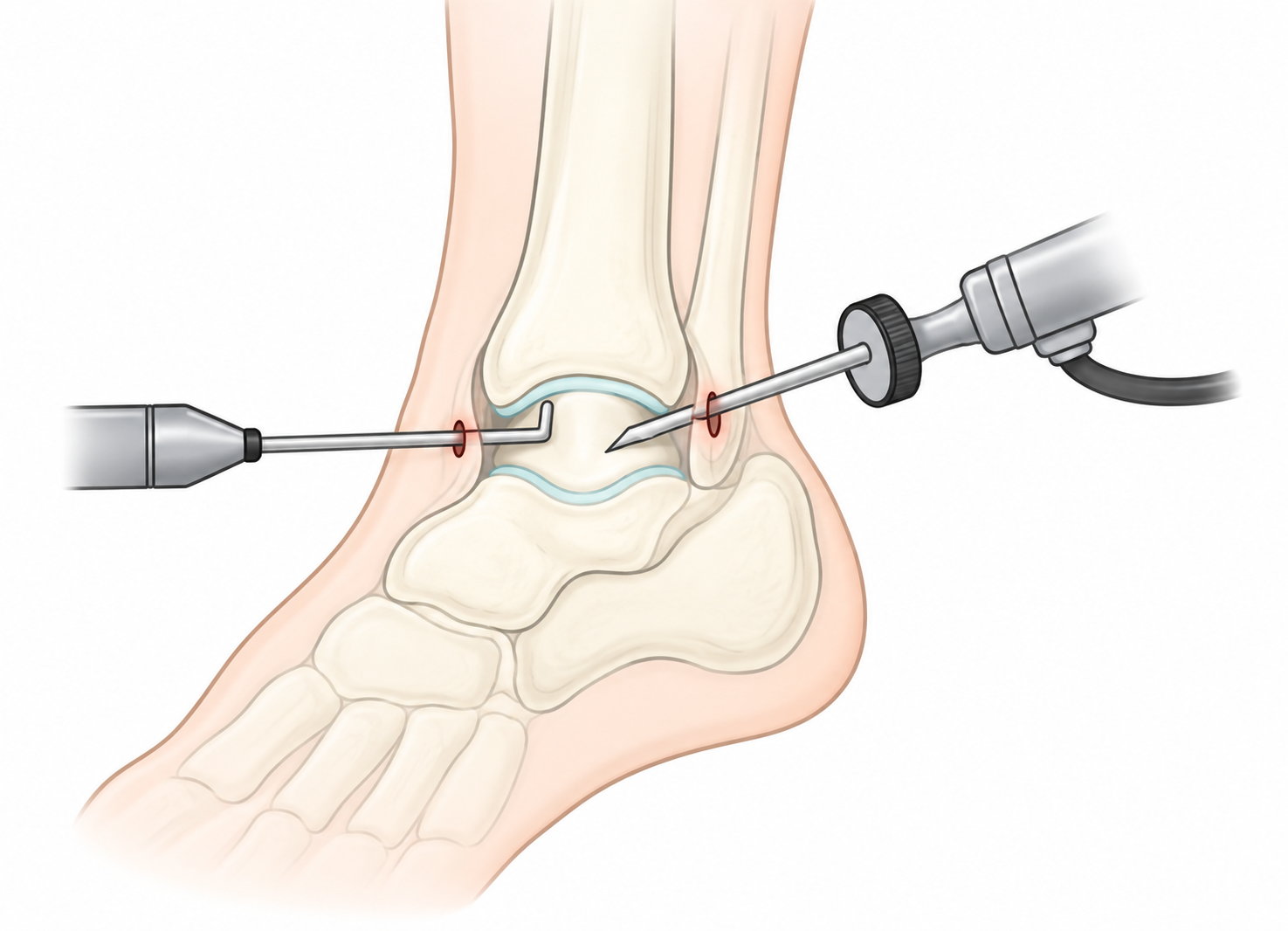
What is ankle arthroscopy?
Arthroscopy (also called minimally invasive surgery) allows the surgeon to see inside your ankle. A small camera is inserted into the joint through a small skin incision. Arthroscopy can be used as a diagnostic method, for example to identify damage to the articular cartilage and ligaments, and to treat pathology with special instruments under camera guidance without large skin incisions.
What are the benefits of arthroscopy?
The main benefit is that the problem (diagnosis) can be identified precisely during the operation and, in most cases, treated during the same procedure. Another benefit is its minimally invasive nature: the postoperative wounds are smaller, pain after surgery is less pronounced, and the patient can return to their usual routine sooner.
What happens during the operation?
The operation may take from 30 minutes to one and a half hours. The surgeon makes small incisions through which the camera and instruments are inserted. Depending on your problem, the skin incisions will be made at the back or front of the ankle. After inserting the camera, the surgeon examines the joint surfaces, cartilage, ligaments and tendons. Depending on the problem, excess fragments of bone and other tissue are removed from the joint. At the end of the operation, the surgeon closes the wounds and applies a sterile dressing.
If the surgeon identifies serious ligament damage, you may require reconstructive surgery, which means a larger incision will be needed.
How should I prepare for surgery?
- Tell your surgeon about every medicine you take daily. Some medicines will need to be stopped for a period before surgery.
- Your surgeon may postpone the operation until you stop smoking. Smoking is also discouraged during the postoperative and healing period. Research shows that smoking delays tissue healing.
- You can reduce the risk of infection by avoiding hair-removal procedures around the surgical area before the operation.
Important advice after surgery:
You will remain in hospital until the evening of the operation or longer if necessary.
Postoperative appointments — you will need regular reviews with your treating doctor. During the review, the dressing is removed and the surgical wound is examined.
Your surgeon will assess whether you need crutches and a plaster splint after surgery.
Physiotherapy is required after your operation.
Returning to work depends on your individual circumstances and type of work. Your surgeon will assess this individually.
Driving depends on the extent of the operation. Your surgeon will assess this individually.
Sport — walking and light exercise may be resumed after an individually determined period.
Possible complications of surgical treatment:
Modern foot surgery has a successful outcome in 90% of cases, but, as with any surgical treatment, there is a known risk of complications.
Pain is normal after surgery; your surgeon will prescribe appropriate pain relief.
Infection develops in a small percentage of patients. Minor infections are more common and usually resolve after a short course of antibiotics.
Bleeding is common after surgery; you may notice blood on the dressing. Bleeding can be reduced by elevating the foot.
Numbness and tingling result from damage to small nerves. Sensory changes are usually temporary but may be permanent.
Scars remain after any operation and may sometimes cause pain and irritation.
Blood clots — deep vein thrombosis (DVT) and pulmonary embolism (PE) are rare complications. Tell your doctor if you have had DVT or PE, or if your family has a history of blood-clotting disorders.
Compartment syndrome is a very rare complication that can occur when fluid used during surgery escapes from the joint into the surrounding tissues.
CONTACT YOUR DOCTOR IF YOU DEVELOP SEVERE PAIN, REDNESS, DISCHARGE FROM THE WOUND, MARKED SWELLING, EXCESSIVE NUMBNESS, TINGLING OR A GENERAL DETERIORATION IN YOUR CONDITION.